Healthcare SEO strategy plays a critical role in today’s healthcare landscape, a clinic’s digital presence is often the first point of interaction with patients. From searching symptoms to selecting providers, patients increasingly rely on online information to make informed decisions.
However, many healthcare websites are still structured as static information platforms rather than patient-centered digital experiences. This creates a gap between what patients need and what clinics provide online.
This case study explores how the digital presence of Ibn Sina Hospital can be improved through a structured SEO and content strategy approach.
Market Context
During the analysis process, a clear contrast emerged between different healthcare markets. Clinics in more digitally mature environments, such as the UAE, often demonstrate structured websites, optimized content, and clearer patient journeys.
In contrast, many clinics in developing markets still rely on outdated digital structures, limiting both visibility and usability.
This highlights a significant opportunity: improving digital strategy can directly enhance patient engagement and access to care.
Healthcare SEO Strategy Challenges (Audit Findings)
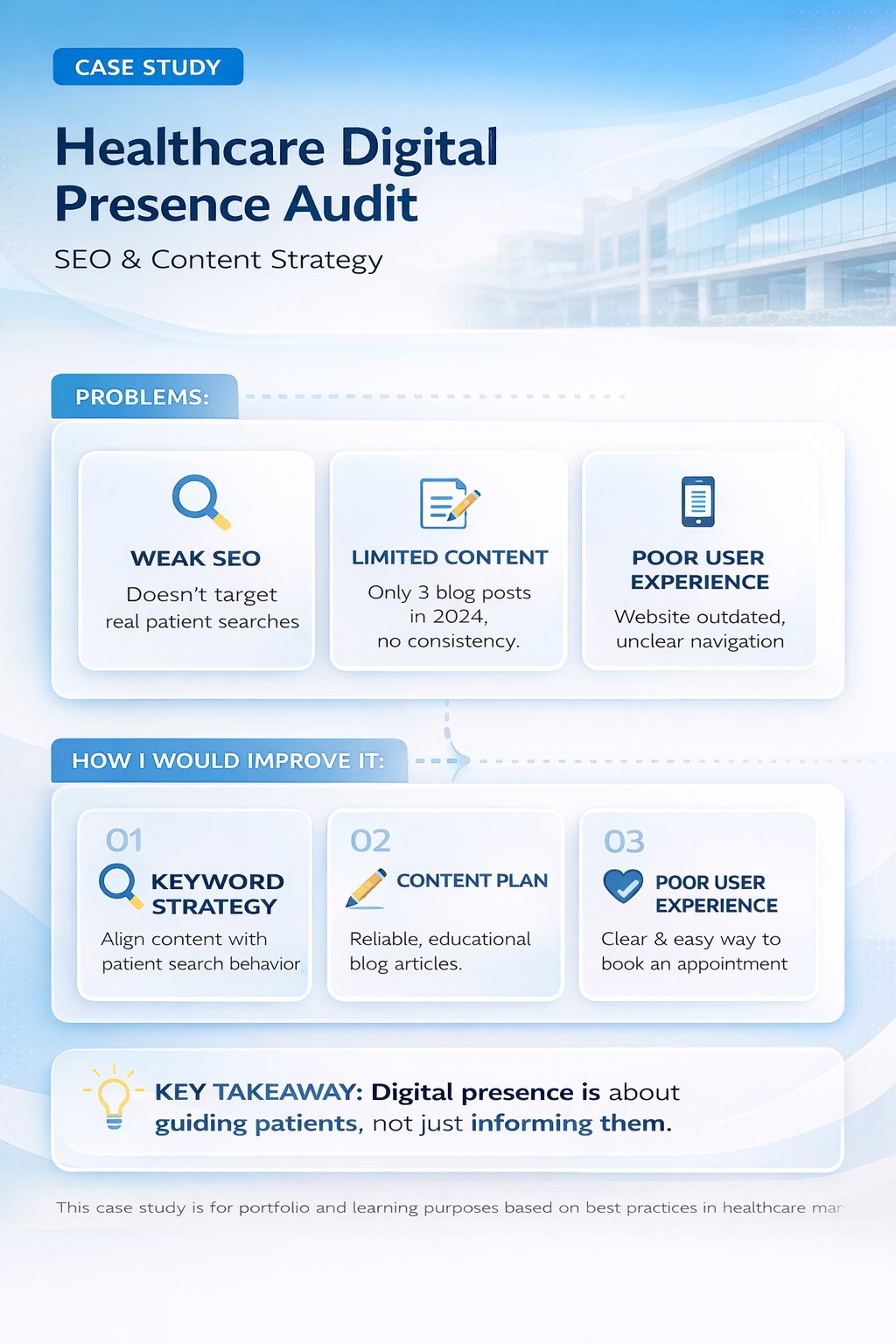
1. Limited SEO Optimization
The website structure does not appear to target specific patient search queries. Service pages are likely built around general medical terms rather than real search behavior.
For example, patients are more likely to search for:
- “heart specialist in Cairo”
- “cardiology clinic in Egypt”
Rather than generic terms such as “cardiology department.”
This limits the website’s visibility in search engines.
2. Weak content strategy
The blog section contains only a few articles, with no clear publishing consistency or thematic structure.
This results in:
- Limited keyword coverage
- Low patient education
- Missed opportunities for organic traffic
The blog exists, but it is not functioning as a strategic growth tool.
3. User Experience and Navigation
The website appears to prioritize institutional information rather than patient needs.
Key issues include:
- Lack of a clear patient journey
- Limited guidance toward booking or contact
- Basic navigation without structured pathways
Patients may struggle to quickly find relevant information or take action.
4. Lack of Trust-Building Content
Healthcare decisions rely heavily on trust. However, the website provides limited content that builds credibility from a patient perspective.
Missing elements may include:
- Patient testimonials
- Educational resources
- Doctor-led insights
This reduces confidence and engagement.
Strategic Recommendations
1. Develop a Patient-Centered SEO Strategy
Content and pages should be aligned with real search intent.
Examples include:
- “Cardiology services in Cairo”
- “Symptoms of heart disease”
- “When to see a cardiologist”
This approach improves discoverability and relevance.
2. Build a Consistent Content Strategy
The blog should become a core growth driver.
Recommended structure:
- Educational articles (symptoms, conditions)
- Decision-support content (when to seek care)
- Trust-building content (doctor insights)
Consistency is key to building authority and visibility.
3. Optimize Website Structure
Each service page should include:
- Clear, keyword-optimized titles
- Patient-friendly explanations
- FAQs addressing common concerns
- Internal links to related content
This improves both SEO performance and user experience.
4. Enhance the Patient Journey
The website should guide users toward action.
Key improvements:
- Clear “Book Appointment” calls-to-action
- Visible contact options
- Mobile-friendly design
A structured journey reduces friction and improves conversion.
Expected Impact
If these improvements are implemented, the clinic could achieve:
- Increased search engine visibility
- Higher patient engagement
- Improved trust and credibility
- Stronger conversion into appointments
Conclusion
Healthcare digital marketing is not only about visibility — it is about guiding patients toward informed decisions.
By aligning SEO, content, and user experience with patient needs, clinics can transform their websites from static platforms into effective growth engines.
This approach reflects a broader shift in healthcare marketing: from information delivery to patient-centered communication.